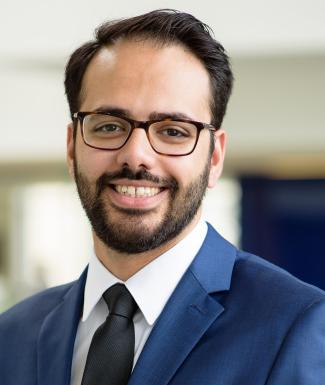
Biography
Farhad Pourkamali is an Associate Professor in the Department of Mathematical and Statistical Sciences at the University of Colorado Denver (CU Denver). Prior to his current role, he served as an Assistant Professor in the Computer Science Department at the University of Massachusetts Lowell (UMass Lowell) from 2018 to 2022. Additionally, he received the Visiting Faculty Research Program (VFRP) award from the Air Force Research Laboratory Information Directorate (AFRL/RI) in 2021. He completed his Ph.D. in Electrical Engineering at the University of Colorado Boulder (CU Boulder) in 2017. His work focuses on enhancing the performance, reliability, and computational efficiency of artificial intelligence (AI) using tools from computational mathematics, statistical inference, and scientific computing.
Research Interests
My research advances the design and deployment of data-driven models that learn predictive distributions for physical systems from observational and simulation data collected under operational conditions rather than curated benchmarks. Specific research goals include developing a mathematical understanding of the capabilities, limitations, and uncertainty of foundation models across modalities; enabling their reliable adaptation in data-scarce and long-horizon environments; and building interdisciplinary collaborations that connect advances in machine learning with challenging scientific and engineering problems. My research spans three closely related areas.
Trustworthy AI
Predictive uncertainty quantification, probabilistic neural networks, conformal prediction with distribution-free guarantees, calibration, selective prediction, label-efficient model evaluation, and quantifying variability across training runs.
Adaptive AI
Continual learning, active learning and testing, knowledge distillation, out-of-distribution generalization in non-stationary and long-horizon environments, and closed-loop systems that determine which data to acquire and when to update.
Scientific AI
Uncertainty-aware surrogate modeling, predictive digital twins, and data-efficient experimental design for scientific discovery, with applications in computational engineering, advanced manufacturing and materials, and remote sensing.
Featured Publications
The complete collection of my publications can be found on Google Scholar.
Probabilistic Neural Networks (PNNs) with t-distributed outputs: adaptive prediction intervals beyond Gaussian assumptions
Pourkamali-Anaraki, F.
Neural Computing and Applications, 38(8), 259.
Predicting printability of highly filled polymer suspensions via vat photopolymerization: a classification-based machine learning approach
Nasrin, T., Pourkamali-Anaraki, F., Hansen, C., Jensen, R., & Peterson, A.
Rapid Prototyping Journal, 31(10), 2182-2194.
Probabilistic Neural Networks (PNNs) for modeling aleatoric uncertainty in scientific machine learning
Pourkamali-Anaraki, F., Husseini, J. F., & Stapleton, S. E.
IEEE Access, 12, 178816-178831.
Application of machine learning in polymer additive manufacturing: A review
Nasrin, T., Pourkamali‐Anaraki, F., & Peterson, A. M.
Journal of Polymer Science, 62(12), 2639-2669.
Evaluation of classification models in limited data scenarios with application to additive manufacturing
Pourkamali-Anaraki, F., Nasrin, T., Jensen, R. E., Peterson, A. M., & Hansen, C. J.
Engineering Applications of Artificial Intelligence, 126, 106983.
Active learning for prediction of tensile properties for material extrusion additive manufacturing
Nasrin, T., Pourali, M., Pourkamali-Anaraki, F., & Peterson, A. M.
Scientific Reports, 13(1), 11460.
Adaptive data compression for classification problems
Pourkamali-Anaraki, F., & Bennette, W. D.
IEEE Access, 9, 157654-157669.
Scalable spectral clustering with Nyström approximation: Practical and theoretical aspects
Pourkamali-Anaraki, F.
IEEE Open Journal of Signal Processing, 1, 242–256.
Grants
High-Throughput Design and Analysis of Novel Ceramics
Funding Agency: Army Research Lab (ARL)
Data Science Approaches to Advance High Solids Loading Additive Manufacturing
Funding Agency: Army Research Lab (ARL)
Multi-Scale Models based on Machine Learning and a Fiber Network Model
Funding Agency: National Aeronautics and Space Administration (NASA)
Learning from Imbalanced Data with Confidence and Minimal Supervision
Funding Agency: Air Force Research Laboratory Information Directorate (AFRL/RI)
Teaching
Due to my interdisciplinary background, I teach a variety of courses at the intersection of computational mathematics, statistical inference, machine learning, and AI.
MATH 6388: Statistical and Machine Learning
MATH 5388: Machine Learning Methods (Graduate)
MATH 4388: Machine Learning Methods (Undergraduate)
MATH 1376: Programming for Data Science
MATH 5718: Applied Linear Algebra
MATH 3382: Statistical Theory
Collaboration & Contact
I welcome opportunities to collaborate across disciplines, support driven students, and advise partners in industry. If you are interested in working together, please see the guidelines below:
- Prospective Students & Research Collaborators: Our group is always looking for motivated students and external research collaborators with a solid background in linear algebra, statistics, or machine learning. If you are interested in working with me, please email me your CV, transcripts, or past research work along with a brief summary of how your background aligns with our research pillars.
- Academic & Industry Research: I am highly open to joint grants and collaborative research projects, particularly in translating reliable AI, computational mathematics, or uncertainty quantification models into remote sensing, physical science, engineering, or medicine.
- Consulting & Advisory Inquiries: I am available for algorithm auditing, technical consulting, and industry expert advisory roles focusing on making AI systems more efficient, reliable, and highly generalizable.
The quickest way to reach out is via email at farhad.pourkamali@ucdenver.edu.